Guide
Types of AI agents: 7 kinds and which one your business needs
Vendors use "AI agent" for almost anything now. Sorting agents by where they work and what they do makes the choice much easier. Here are the seven kinds a business is likely to meet, in plain words.
The chat opens in a new tab. No sign-up needed.
HindiEnglishYour calling hours
Short answer
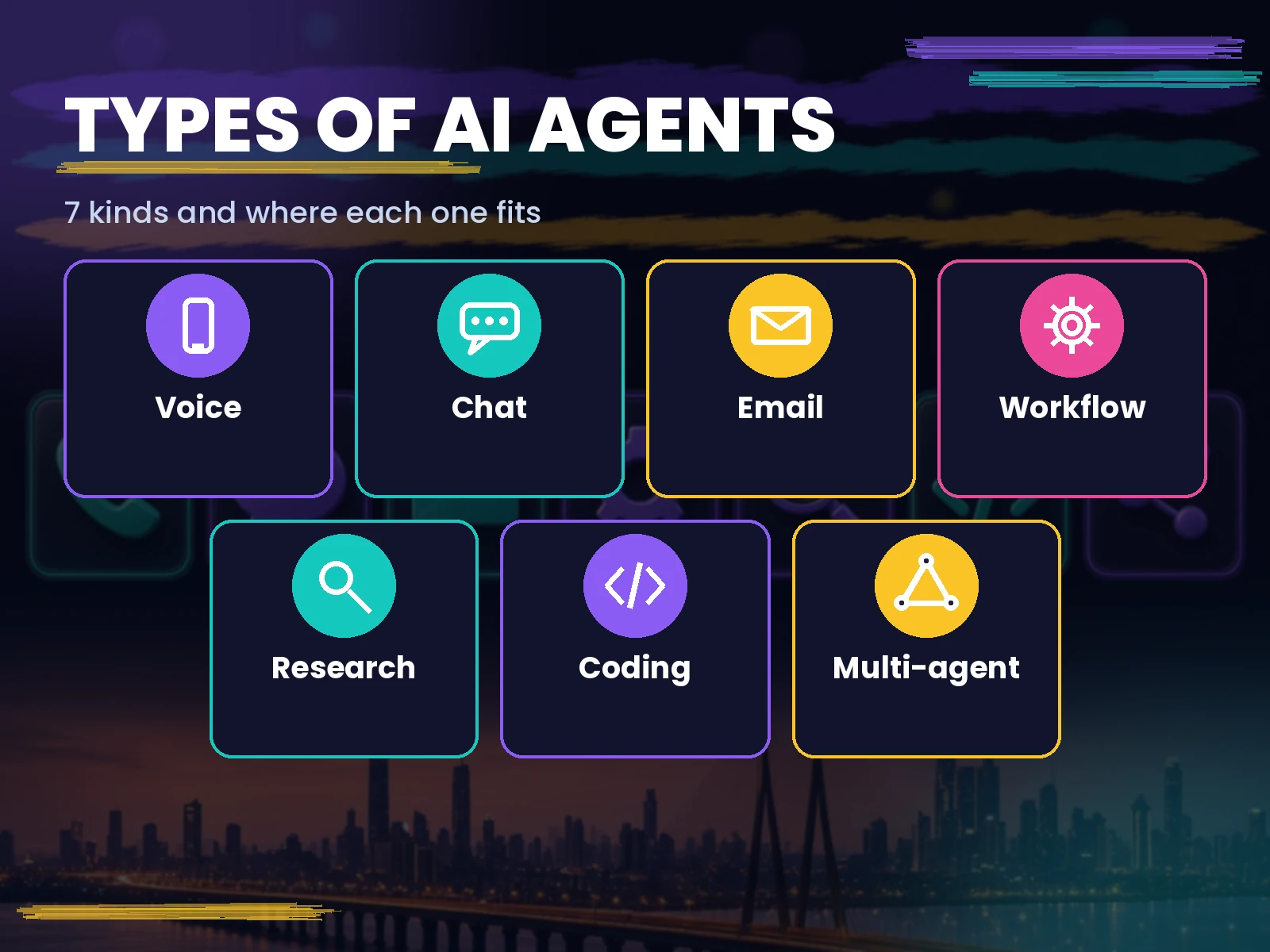
There are seven types of AI agents a business is likely to meet: voice agents that handle phone calls, chat agents on websites and messaging apps, email agents that sort and draft replies, workflow agents that move work between systems, research agents that gather and summarise information, coding agents that help developers, and multi-agent systems in which several agents share one job. Most businesses should start with the type closest to their busiest customer channel.
How should you sort the types of AI agents?
There are two common ways to group AI agents. Textbooks group them by how they make decisions. Buyers are better served by grouping them by where they work, such as on the phone, in a chat window or inside your back office, because that tells you who they talk to and what they can change. This guide uses the practical grouping, but here is the textbook one too, since you will see the terms on other sites.
What about the textbook types of agents?
- Simple reflex agent
- Reacts to what is in front of it with fixed rules, like a thermostat. No memory, no planning.
- Model-based agent
- Keeps a picture of the situation in mind, so it can act sensibly when not everything is visible.
- Goal-based agent
- Chooses actions that move it closer to a stated goal, such as a booked appointment.
- Utility-based agent
- Weighs several possible outcomes and picks the one that is best overall, not just acceptable.
- Learning agent
- Improves its behaviour over time from feedback on what worked.
Most business agents today are goal-based agents built on a language model, with some learning added through the reviews and script changes that people make every week.
The 7 kinds of AI agents at a glance
| Type | Where it works | A typical job | Usually a good first fit for |
|---|---|---|---|
| Voice agent | Phone calls, in and out | Follow up enquiries, confirm visits, send reminders | Businesses whose customers prefer to talk |
| Chat agent | Website chat and messaging | Answer typed questions, collect contact details | Busy websites and online shops |
| Email agent | The shared inbox | Sort messages, draft routine replies | Teams flooded with similar emails |
| Workflow agent | Between your software tools | Move an enquiry from a form to the right person | Operations with many hand-offs |
| Research agent | The web and your documents | Collect and summarise information | Analysts, planners and founders |
| Coding agent | Code editors and repositories | Write, test and fix code with a developer | Software and IT teams |
| Multi-agent system | Across several of the above | Split one big job between specialist agents | Larger, more complex processes |
The types overlap. A voice agent might hand its notes to a workflow agent, and a chat agent might ask a research agent for an answer. Think of the list as job descriptions rather than separate products.
Voice agents: when the customer is on the phone
A voice agent listens to speech, works out what was meant, replies in a natural voice and acts on the result. It is the type closest to a human telecaller, and in India it matters more than in many markets because so many customers still prefer a call to a form or a chat.
What separates a good voice agent from a frustrating one is mostly practical: how well it handles interruptions, mixed languages and weak lines, and how cleanly it passes a caller to a person. Swara AI is built around this type. Its calling agent holds conversations in Hindi and English and in regional languages such as Tamil, Marathi, Bengali, Gujarati, Telugu, Malayalam and Kannada, and follows the caller when they change language. Our guide to AI voice agents in India goes deeper.
Chat and email agents: when the customer writes
Chat agents
A chat agent sits in the chat window of a website or a messaging channel. It answers questions from your own information, asks for a name and number when the visitor is interested, and passes the conversation to your team. It suits customers who are already browsing and want a quick written answer.
Email agents
An email agent reads incoming mail, sorts it by topic and urgency, drafts replies to routine questions for a person to approve, and highlights the messages that need care. It saves the most time where many emails ask the same few things.
Both types share a weakness: they wait for the customer to write first. If your enquiries go cold because nobody calls back in time, a written channel alone will not fix that.
Workflow and research agents: the work behind the scenes
Workflow agents
A workflow agent connects your tools. When a form is filled, it can check for a duplicate, add the enquiry to your records, decide which team should own it and start the right follow-up. Customers never see it, but they feel it when nothing falls through the cracks.
Research agents
A research agent is given a question, searches the sources it is allowed to use, reads them and writes a summary with where each point came from. It is a strong assistant for preparing a market note or a competitor overview, as long as a person checks the sources before anyone relies on it.
Free advice
Talk to our team about AI agents for your calls
Share your name and WhatsApp number. Our team will call you within 24 hours to understand your calls. No payment, no commitment.
Coding agents and multi-agent systems: mostly for tech teams
A coding agent works alongside a developer: it reads the code, suggests changes, writes tests and fixes small bugs, with the developer reviewing every change. Unless you employ software developers, this type is unlikely to be your first.
A multi-agent system splits one large job between several specialist agents, for example one that talks to the customer, one that checks stock and one that prepares the paperwork, coordinated by a supervising agent. These systems are powerful but harder to test, because a mistake can pass quietly from one agent to the next.

Which type of AI agent does your business need?
Four honest questions usually settle it in one meeting.
Where do customers reach you most?
If it is the phone, start with a voice agent. If it is your website, start with chat.
Where do enquiries go cold?
Slow first call-backs point to a voice agent; a messy hand-off between tools points to a workflow agent.
What would a mistake cost?
Begin with jobs where a slip is easy to fix, such as a reminder, not a contract.
Who will review the work?
Every type needs a named person who reads its records, at least for the first few weeks.
| Situation | Start with |
|---|---|
| Many enquiries from ads, but few get a call back the same day | Voice agent |
| Visitors ask the same questions on the website again and again | Chat agent |
| A shared inbox where routine mails pile up | Email agent |
| Leads copied by hand from forms into a spreadsheet | Workflow agent |
| Owners spending evenings reading reports and tenders | Research agent |
Can different types of AI agents work together?
Yes, and that is often where the value multiplies. A common pattern for an Indian sales team looks like this: a visitor asks a question in website chat and leaves a number, a workflow agent files the enquiry, a voice agent calls within your calling hours to understand the need, and an interested caller is transferred to a salesperson along with a summary of the call. Each agent does one job well, and people step in where judgement is needed.
Start with one type, prove it on real customers, then add the next. Building all of them at once makes it hard to tell what is working.
What mistakes should you avoid when picking a type?
- Choosing the most impressive-sounding type instead of the one that matches your busiest channel.
- Buying a chat agent when your customers mostly phone, or a voice agent when they never pick up unknown numbers.
- Skipping the hand-over plan. Every type needs a clear route to a person.
- Judging a demo built for another industry. Ask to hear or see your own kind of conversation.
- Measuring activity, such as messages sent, rather than outcomes, such as visits booked or questions resolved.
For a wider set of answers on AI calling, see the AI calling FAQ and guides.
Questions people ask
How many types of AI agents are there?
It depends on how you count. Textbooks list five decision styles, from simple reflex to learning agents. For business use, seven practical kinds cover almost everything: voice, chat, email, workflow, research, coding and multi-agent systems.
Which type of AI agent is most useful for sales follow-ups?
Usually a voice agent, because a quick, personal call to a new enquiry is what moves most Indian buyers to the next step. A workflow agent can make sure every enquiry reaches it.
What is the difference between a voice agent and a chat agent?
A voice agent talks with people on phone calls; a chat agent replies to typed messages. A voice agent can reach out first, while a chat agent usually waits for the visitor to start.
Is a multi-agent system worth it for a small business?
Rarely at the start. One well-run agent on your busiest channel gives most of the benefit. Multi-agent designs make sense when one process has several distinct, high-volume steps.
Are coding agents useful if we are not a software company?
Only if you have developers building or maintaining your own systems. Otherwise your first agent should face customers or tidy up your internal work.
What is a goal-based agent?
An agent that chooses each step by asking what brings it closer to a stated goal, such as a confirmed booking. Most business voice and chat agents work this way.
Can one provider offer several types of AI agents?
Some do, but depth matters more than range. Check how well the provider handles your main channel before you look at extras.
Which type of AI agent works best for Indian customers who prefer calls?
A voice agent that speaks their language, copes with mixed Hindi and English, and transfers smoothly to a person when the caller wants one.
Do workflow agents need our software to be connected?
Yes. A workflow agent can only move information between tools it has access to, so list the tools involved before you start.
Where can I learn more about voice agents specifically?
Read what AI agents are, then how an AI voice agent is built, or put your question to our AI agent in the chat.
Questions about AI calling for your business?
Ask our AI agent. It answers in seconds, at any time of day.
Get a call back within 24 hours
Leave your name and number. Our team will call you within 24 hours to understand your calls and explain whether an AI calling agent fits your business.
- No payment or commitment
- Your details are used only to reply to your enquiry
- Prefer to type? Ask our AI agent in the chat