Guide
What are AI agents? A plain-language guide for Indian businesses
An AI agent is software that is handed a goal and works towards it, step by step, instead of answering one question and stopping. Here is what that means in everyday words, with a single phone call as the worked example.
The chat opens in a new tab. No sign-up needed.
HindiEnglishYour calling hours
Short answer
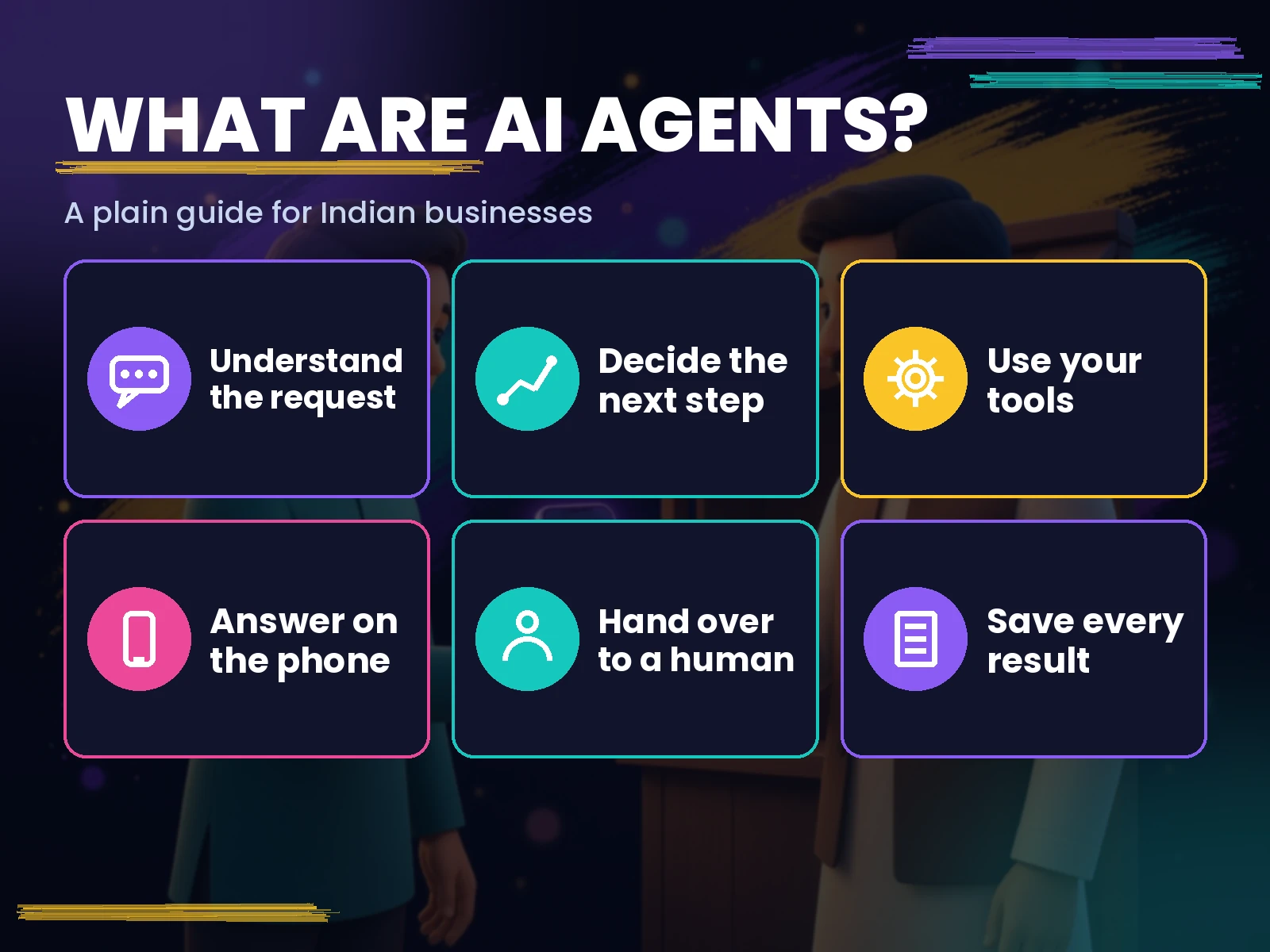
An AI agent is software that is given a goal, understands what is happening, decides the next step and then takes an action, such as booking a slot or passing a call to a person, within rules the business sets. A chatbot replies to a message; an agent carries a task through to the end. For most Indian businesses the clearest place to see one at work is a phone call, where a voice agent talks, asks, books and reports back.
What is an AI agent, in one paragraph?
Picture a capable new assistant on their first day. You do not hand them a list of every sentence to say. You tell them the job ("call yesterday's enquiries and find out who wants a visit"), what they may and may not promise, and when to come and get you. An AI agent works the same way. It is given a goal and some boundaries, and then it works out the steps on its own: what to ask, how to respond to the answer, and what to do once the conversation reaches a result.
That is the real difference from older software. A program follows the exact path a developer drew. An agent chooses its path, inside the fence you built, based on what it hears or reads in the moment.
- A goal
- The outcome it is working towards, such as a confirmed appointment or a qualified enquiry.
- Understanding
- The ability to follow ordinary language, including half-sentences, changes of mind and mixed languages.
- Decisions
- Choosing the next step: another question, an answer, a booking, a hand-over or a polite goodbye.
- Actions
- Doing something in the real world, not only talking: saving a slot, transferring a call, logging a result.
- A record
- A trail of what it did and why, so a person can check the work afterwards.
How is an AI agent different from a chatbot or a simple automation?
The three words get used loosely, which is why so many businesses are confused about what they are buying. A useful test is to ask what happens when the customer says something nobody planned for.
| Rule-based automation | Basic chatbot | AI agent | |
|---|---|---|---|
| How it starts | A trigger, such as a form being filled | A message from a person | A goal plus a trigger or a message |
| Unplanned replies | Breaks or ignores them | Falls back to a menu | Works out a sensible next step |
| Takes real actions | Only the one it was built for | Rarely | Several, chosen during the task |
| Keeps track of the task | No | Within one chat, partly | Across the whole task |
| Needs a person when | Anything changes | The question is off the list | The rules say so, or it is unsure |
None of these is "better" in every case. A plain automation that sends a confirmation message is perfect for that one job. An agent earns its place when the conversation can go several ways and someone still has to reach an outcome.
A worked example: an AI voice agent on one phone call
Phone calls are the easiest place to see an agent think, because every decision happens out loud. Imagine a furniture showroom in Pune. A customer fills in an enquiry form late at night. Here is what an AI voice agent does with it.
It plans the call
The enquiry arrives after hours, so the agent schedules the first call for the morning, inside the showroom's calling hours.
It opens politely
It says who is calling and why, then checks whether this is a good moment to talk.
It listens and follows
The customer says she wants a sofa, but mainly wants to know about delivery to a top-floor flat.
It decides what matters
Instead of reading out the full product list, it answers the delivery question from the approved notes.
It acts
She asks to see the sofas in person, so it offers two visit slots and confirms one.
It hands over the hard part
She asks for a special discount. That is not the agent's call, so it promises a call-back from the team.
It reports
A short summary, the recording and the agreed visit time go to the showroom team.
Notice that nobody scripted "talk about top-floor delivery first". The agent heard what the customer cared about and adjusted. That flexibility, combined with knowing when to stop and pass the call on, is what makes it an agent.
What makes something an agent and not just a clever script?
Under the hood, almost every AI agent runs the same loop, over and over, until the goal is reached or a person takes over.
- Notice: take in the latest information, such as what the caller just said or a new form entry.
- Think: compare it with the goal and the rules, and pick the most useful next step.
- Act: say something, look something up, book a slot or move the task to a person.
- Check: see whether the action worked, then go round the loop again.

A script has no "check" step. It plays line seven after line six whatever happened in between. An agent looks at the result of each step before choosing the next one, which is why it can recover when a customer interrupts, changes the subject or gives an answer nobody expected.
Free advice
Talk to our team about AI agents for your calls
Share your name and WhatsApp number. Our team will call you within 24 hours to understand your calls. No payment, no commitment.
Where do AI agents fit in an Indian business today?
On the phone
Following up fresh enquiries, confirming visits and reminding customers about dues, in the language they speak.
In website chat
Answering questions a visitor types and collecting their details for the team.
In the inbox
Sorting incoming emails, drafting routine replies and flagging the ones a person must read.
Between your tools
Moving an enquiry from a form into your records and starting the right follow-up.
For your staff
Answering internal questions about process, stock or policy from your own documents.
For research
Collecting and summarising information, such as tenders or market updates, for a person to review.
For a business where customers prefer to talk rather than type, the phone is usually where an agent makes the biggest difference first, because that is where the most time goes and the most enquiries go cold.
What can AI agents not do yet?
- Use real judgement on situations that are new to everyone, such as a customer's unusual complaint or a delicate refund.
- Know facts nobody gave them. An agent working from your notes is only as accurate as those notes.
- Replace trust built over years. Long-standing customers often want the person they know.
- Take responsibility. The business that deploys an agent remains answerable for what it says and does.
- Read the room perfectly. Sarcasm, grief and anger are still hard, and those calls should go to people.
Treat these limits as the outline of a good hand-over plan rather than as reasons to wait.
How do you keep an AI agent under control?
An agent is only as safe as the fence around it. Four settings do most of the work, and you should be able to see and change each of them with whoever sets up your agent.
- A narrow goal: one job per agent, written in a sentence.
- A list of allowed actions: for example book, transfer, schedule a call-back, and nothing else.
- Hand-over triggers: the moments it must pass the conversation to a person, such as a complaint or a price request.
- Records you actually read: recordings and summaries, reviewed every week at first.
Where should you start if you want to try one?
Start where the work is repetitive and the outcome is easy to check. For many businesses that is the first call to a new enquiry. Swara AI focuses on exactly that kind of agent. Ours talks with your enquiries in Hindi, English or a regional language, keeps to the calling hours you choose, puts interested people through to your team and leaves a written record of each conversation. To see how a dedicated calling agent is set up for a business, read about AI calling agents for Indian businesses, or start with our own guide to the AI calling agent.
Questions people ask
Is an AI agent the same thing as artificial intelligence in general?
No. Artificial intelligence is the broad field. An AI agent is one way of using it: software that pursues a goal by deciding and taking steps, rather than only producing an answer when asked.
Do AI agents work without any human involvement?
They can complete routine tasks on their own, but people still set the goal and rules, handle the hand-overs and review the results. A well-run agent is supervised, not left alone.
What is the simplest example of an AI agent?
A voice agent that calls a new enquiry, asks two or three questions, books a visit if the person is interested and sends the result to your team. It has a goal, makes decisions during the call and takes real actions.
Can a small business use AI agents, or are they only for large companies?
Small businesses often benefit the most, because they have the fewest people to answer and follow up every enquiry. Starting with one narrow job keeps it simple.
Is a voice agent on a phone call really an AI agent?
Yes, when it listens to free replies, decides the next step and acts, for example booking or transferring. A recorded message or a press-1 menu is not an agent.
Do AI agents remember past conversations?
Within a task they keep track of what has been said. Whether they remember earlier calls with the same person depends on how they are connected to your records, so ask about it when you compare options.
What does an AI agent need from my business to work well?
A clear goal, accurate notes on your products and process, the rules about what it may promise, and a person who receives hand-overs. Gaps in any of these show up quickly in the calls.
Can an AI agent make a mistake?
Yes. It can mishear a word or misjudge a request. That is why hand-over rules, records of every conversation and regular reviews matter, so mistakes are caught and the instructions improved.
How should customer data be handled when an agent talks to customers?
Ask whoever runs the agent where recordings and transcripts are kept, who can see them and how long they are stored. Collect only what the task needs.
How does Swara AI relate to AI agents?
Swara AI explains AI calling, which uses one kind of AI agent: a voice agent for phone calls. Ours works in Hindi, English and regional languages, passes interested callers on to your staff and summarises every call for you.
Questions about AI calling for your business?
Ask our AI agent. It answers in seconds, at any time of day.
Get a call back within 24 hours
Leave your name and number. Our team will call you within 24 hours to understand your calls and explain whether an AI calling agent fits your business.
- No payment or commitment
- Your details are used only to reply to your enquiry
- Prefer to type? Ask our AI agent in the chat