Guide
Conversational AI in India: where it works and where it does not
India tests conversational AI harder than most places: several languages in one sentence, a dozen accents for each language and calls taken on scooters and in markets. Here is an honest map of what works today and what still needs a person.
The chat opens in a new tab. No sign-up needed.
HindiEnglishYour calling hours
Short answer
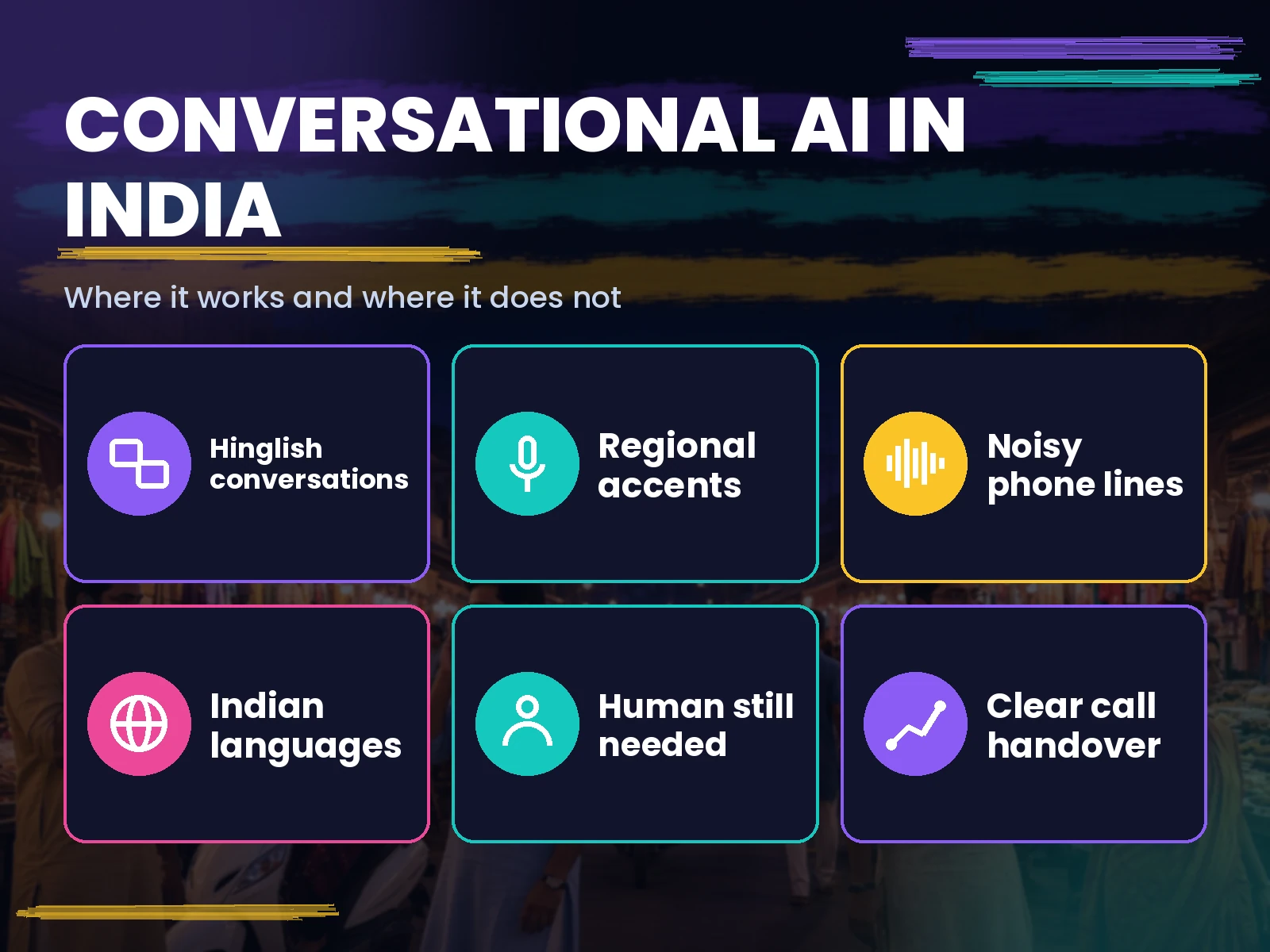
Conversational AI in India means software that talks with people in everyday speech, in Hindi, English, Hinglish and regional languages, on phone calls and in chat. It works well for short, predictable conversations such as enquiry follow-ups, reminders, confirmations and common questions. It struggles with very noisy lines, unusual topics in heavily mixed language, emotional or sensitive calls and anything needing negotiation or judgement, which is where a person should take over.
What is conversational AI, and why is India a special case?
Conversational AI is the family of technology that lets software hold a natural conversation: it understands what a person says or types, keeps track of the exchange and replies in ordinary language. On the phone it combines speech recognition, a language model and a synthetic voice; in chat it skips the speech parts.
India stretches every one of those parts. Customers switch languages mid-sentence, pronounce English words in many regional ways, take calls in loud places on patchy networks, and expect a level of politeness that a literal translation often misses. A system tuned only on neat, single-language speech can sound fine in a demo and stumble on a real list.
Hinglish and code-mixing: how well does it cope?
Mixing Hindi and English is not an edge case in India; for many callers it is simply how they talk. Modern systems handle common mixing well, especially in everyday topics like timings, locations and bookings. Here is the kind of exchange a good voice agent should manage without fuss.
Example: a mixed Hindi and English exchange (a fictional clinic)
- Agent
- "Namaste, City Care Clinic se bol rahe hain. Aapka appointment kal ke liye confirm karna tha."
- Caller
- "Haan, but kal morning possible nahi hai, evening mein ho sakta hai kya?"
- Agent
- "Bilkul. Kal evening ke liye 5 baje ya 6 baje, kaunsa time theek rahega?"
- Caller
- "Six o'clock theek hai."
- Agent
- "Done, kal shaam 6 baje. Team aapko confirm kar degi. Dhanyavaad!"
Where mixing still causes trouble
- Numbers said half in Hindi and half in English, such as a pin code or an amount, which is why key details should be read back.
- Uncommon technical or trade words dropped into a regional-language sentence.
- Very fast speech with several people talking at once on speakerphone.
Accents and regional languages
Each Indian language comes with wide variation in accent, vocabulary and pace from one district to the next. A Marathi speaker from Kolhapur and one from Nagpur will not sound alike, and the English of a caller in Kochi differs from that of a caller in Lucknow. Good conversational AI is tested on that variety, not on a single studio voice.
Swara AI calls in Hindi and English, and also in Tamil, Telugu, Kannada, Malayalam, Bengali, Gujarati and Marathi, moving between them when the caller does. Language support is only the start, though. The things to listen for in any sample call are how it says local names and places, whether it waits for slower speakers to finish and whether its tone fits the region.
Choosing the opening language
Open in the language most of your list speaks, and offer a switch early. Our guide to AI calling in Hindi and regional languages covers how to write scripts for each.
Noisy calls and weak networks
Indian calls happen in traffic, in shops, at construction sites and on trains. Lines drop, voices cut out and a television blares in the background. No system hears perfectly through all of that, so what matters is how it behaves when it is unsure.
- It asks again, politely, rather than guessing what it did not catch.
- It repeats the important bits back, for example the day, the slot or the locality, so errors are caught while the caller is still on the line.
- It offers to call back later when the line is too poor for a proper conversation.
- It keeps sentences short, so a brief drop does not lose the whole point.
Free advice
Talk to our team about AI agents for your calls
Share your name and WhatsApp number. Our team will call you within 24 hours to understand your calls. No payment, no commitment.
Where does conversational AI work well in India?
First follow-up on enquiries
A quick, friendly call to someone who just asked, checking interest and the next step.
Appointment and visit confirmations
Short, predictable calls with a clear yes, no or new time.
Reminders
Renewals, documents, dues and upcoming classes, with a polite nudge.
Event and launch invitations
Inviting past customers and noting who plans to come.
Common questions
Timings, location, documents needed and process steps from approved notes.
Feedback after a visit
A few short questions while the experience is still fresh.
The common thread is a conversation with a limited range of likely answers and a clear outcome to record.
Where does it not work yet, and needs a human?
Leave to conversational AI
- Routine questions with known answers
- Booking, confirming and rescheduling
- Collecting a few details before a hand-over
- Polite reminders with a clear next step
Keep with your people
- Complaints, disputes and angry callers
- Bereavement, illness and other sensitive situations
- Medical, legal or financial advice
- Price negotiation and closing large deals
- Confused or distressed callers who need patience
A well-designed system recognises these moments and transfers the call to a person rather than pressing on. If a sample call keeps going when it should hand over, that is a warning sign.
How do you test conversational AI with real Indian callers?
Use your own customers' language
Test with the mix of languages and accents your list really has, not only clear English.
Play difficult callers
Ask colleagues to interrupt, mumble, switch language and go off topic.
Call from noisy places
Try a market, a moving car and a speakerphone, and see how it recovers.
Check names and numbers
Give it local names, landmarks and phone-style numbers and listen to what it repeats back.
Test the hand-over
Ask for a person and confirm the transfer reaches your team with context.
Start small
Run a small batch of real calls, listen to the recordings and fix the script before widening.
Courtesy and rules for automated calls in India
Callers in India are more forgiving of an AI that is polite, quick and clear about who is calling. Introduce the business at the start, keep the call short, respect a no the first time and stay within sensible calling hours. Call only people who expect to hear from you, and keep a do-not-call list.
Telemarketing is regulated in India. Getting consent, honouring DND registrations and keeping a record of both fall to the business that makes the calls. This is general information, not legal advice, so check the current rules for your type of call with your telecom provider or adviser.
Want the same ideas explained in everyday Hinglish? Read AI calling kya hai, in simple Hinglish.
Questions people ask
Can conversational AI understand Hinglish properly?
For everyday topics such as bookings, timings and locations, modern systems handle Hinglish well. Uncommon words and numbers said in mixed language are harder, which is why key details should be read back to the caller.
Does conversational AI work in Tamil, Bengali or Marathi?
Yes. Bengali, Marathi and Tamil are all among the regional languages Swara AI uses, along with Gujarati, Telugu, Kannada and Malayalam. Always judge a sample call in the exact dialect your customers speak.
How does it cope with a caller who has a strong regional accent?
It does best when it has been tested on similar voices. A good system asks again when unsure instead of guessing, and passes the call to a person if it still cannot follow.
What happens on a call with a lot of background noise?
The agent should ask the caller to repeat, confirm key details aloud and offer to call back if the line is too poor. Forcing a conversation through heavy noise helps nobody.
Is conversational AI good enough for customer complaints?
Not on its own. It can note the basic details politely, but a complaint should reach a person quickly, because it needs judgement and empathy.
Do older customers find AI calls difficult?
Some do, especially if the voice is fast. Short sentences, an unhurried pace and a quick route to a human help older callers the most.
Can it read out numbers, dates and addresses clearly?
Yes, if the script is written for speech, for example "Saturday the 14th at 5 in the evening" rather than a raw date format. Test this in every language you plan to use.
Is conversational AI the same as a chatbot?
A chatbot is one kind of conversational AI, working in text. Conversational AI also covers voice agents that talk on phone calls.
How should we introduce the AI at the start of a call?
Say which business is calling and why, in one or two short sentences, and offer a person if the caller would rather speak to one. Clarity up front builds trust.
Where can I hear conversational AI in my language?
Fill in the call-back form below and our team will phone you within 24 hours to talk through calls in your language. You can also type your questions to our AI agent in the chat.
Questions about AI calling for your business?
Ask our AI agent. It answers in seconds, at any time of day.
Get a call back within 24 hours
Leave your name and number. Our team will call you within 24 hours to understand your calls and explain whether an AI calling agent fits your business.
- No payment or commitment
- Your details are used only to reply to your enquiry
- Prefer to type? Ask our AI agent in the chat