Guide
How to build an AI voice agent: the 6 parts, and build vs buy
An AI voice agent looks like one product from the outside. Inside, it is six parts that must hand work to each other smoothly, in the gaps of a real conversation. Here is what each part does, how to put them together, and when it makes more sense to buy.
The chat opens in a new tab. No sign-up needed.
HindiEnglishYour calling hours
Short answer
To build an AI voice agent you need six parts working together: a phone line that places and receives calls, speech-to-text that turns the caller's words into text, an AI model that decides what to say and do, a voice that speaks the reply, actions such as booking or transferring, and reports that record every call. Building gives full control but needs engineers and ongoing upkeep; for most businesses that simply want calls handled, a managed service is quicker and simpler.
What are the six parts of an AI voice agent?
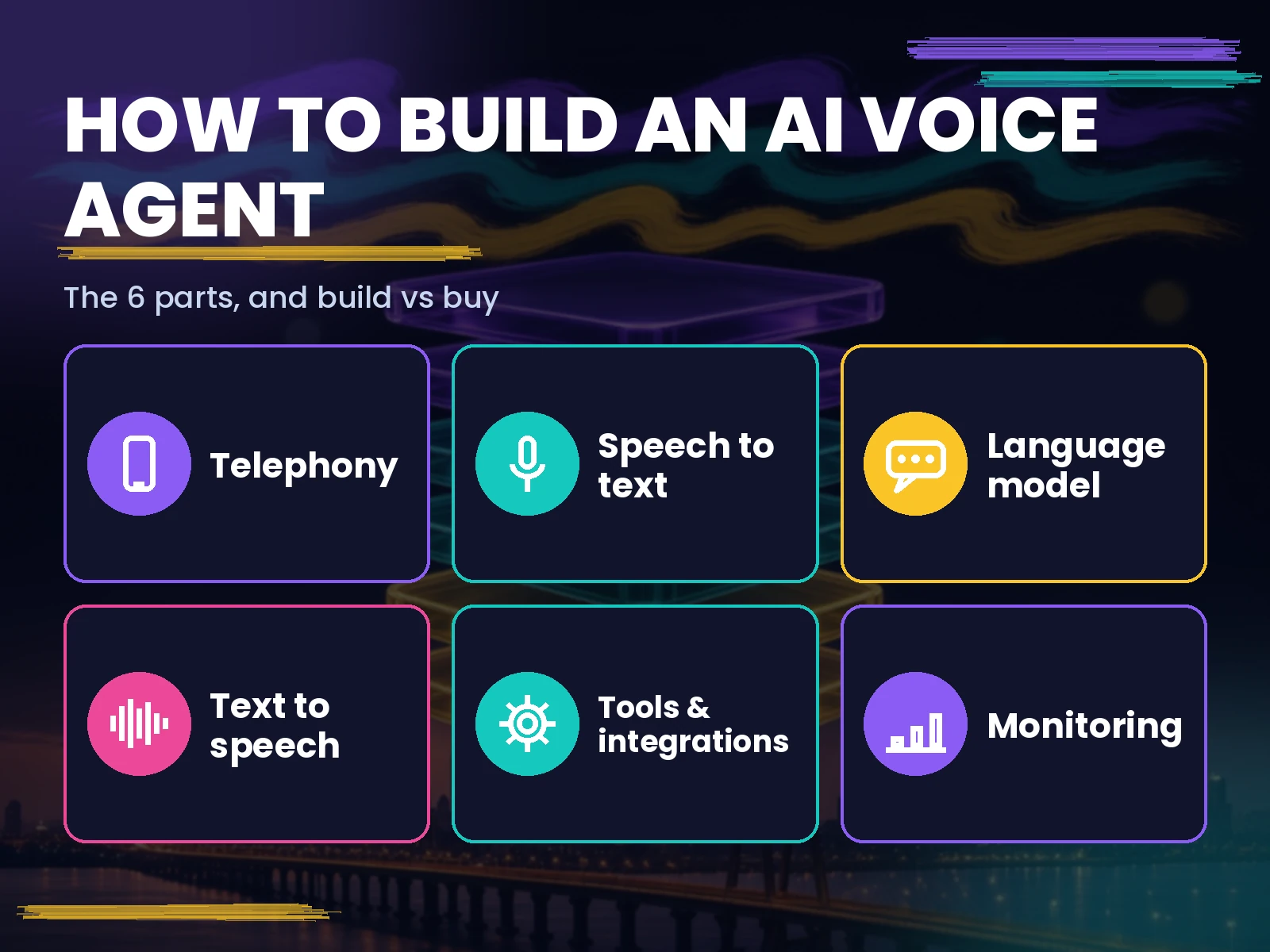
Every voice agent, however it is marketed, is a chain of these six parts. A conversation flows down the chain and back up for each turn: the caller speaks, the agent hears, thinks, answers and, when it is time, does something.
Phone line
Connects the agent to the phone network so it can make and receive calls.
Speech-to-text
Listens to the caller and turns their words into text as they speak.
AI model
Reads the text, follows the script and rules, and decides the reply and the next action.
Voice
Turns the reply into natural speech in the right language and tone.
Actions
Does the work: books a slot, transfers the call, schedules a call-back, ends politely.
Reports
Saves the recording, transcript, summary and outcome so people can see what happened.
Part 1: the phone line
The phone line is the least glamorous part and often the hardest to get right in India. You need numbers that can place outbound calls and receive inbound ones, enough capacity to run several calls at once, a caller identity that customers recognise, and call quality good enough for speech recognition to work.
There are rules too. Commercial calling in India runs through registered telecom routes, and promotional calls come with conditions on consent, DND preferences and calling hours. A team building its own agent has to arrange this with a telecom provider, and keep up when the rules change. This is general information, not legal advice.
Parts 2 to 4: hearing, thinking and speaking
Speech-to-text
This part has to cope with Indian reality: mixed languages, regional accents, background noise and phone-line audio that is far poorer than a studio recording. It should stream, meaning it starts producing text while the caller is still talking, so the agent is ready to reply the moment they finish.
The AI model
The model is the decision-maker. It is given the script, your approved notes and the list of allowed actions, and for each turn it chooses what to say and whether to act. Most of the build effort here goes into instructions and testing: keeping replies short, stopping it from inventing facts, and making it hand over when it should.
The voice
Text-to-speech turns the reply into audio. Listen for a natural pace, correct pronunciation of local names and places, and the right tone for your customers. A voice that sounds perfect in English can sound flat or foreign in Marathi.
Why timing matters most
The three parts together must reply within the natural pause of a conversation. Too slow and callers say "hello?" and talk over the agent. The agent also needs barge-in, which lets the caller interrupt and makes the agent stop and listen, just as a person would. Getting turn-taking right is usually the hardest engineering problem in the whole build.
Parts 5 and 6: actions and reports
Talking is only half the job. An agent that cannot act leaves your team to redo the work, and one that does not report leaves you guessing about what was said.
- Actions connect the model to the outside world: offering and saving a slot, transferring the call live to a person, scheduling a call-back at the time the caller asked for, marking a number as do-not-call.
- Reports give every call a recording, a transcript, a short summary and an outcome tag, such as interested, call later or not interested, so your team can act and managers can spot patterns.

Plan the hand-over with as much care as the conversation. Decide who receives transfers, what happens when nobody is free, and how the summary reaches them before they say hello.
A simple build plan, step by step
Choose one call
Pick one repeated call with a clear outcome, such as confirming next-day appointments.
Write the script and notes
How it opens, what it asks, which facts it is allowed to give and how it answers common objections.
Pick the components
A telecom route, speech-to-text, an AI model and a voice that all handle your languages.
Wire up turn-taking
Streaming, barge-in and short replies, tuned until the conversation feels natural.
Add actions and reports
Booking, transfer, call-back and do-not-call, plus recordings and summaries.
Test with real voices
Colleagues play awkward callers in noisy places and different languages.
Launch small and watch
Run a small batch, listen to the recordings and fix what you hear before you scale.
Free advice
Talk to our team about AI agents for your calls
Share your name and WhatsApp number. Our team will call you within 24 hours to understand your calls. No payment, no commitment.
What usually goes wrong in a home-made voice agent?
- Long silences before each reply, so callers hang up or talk over the agent.
- No barge-in, so the agent keeps speaking when the caller tries to interrupt.
- Misheard numbers and names, with nothing read back to catch the mistake.
- Answers that drift beyond the approved notes, sometimes promising things the business never offered.
- No clear hand-over path, so interested callers end up stuck with the agent.
- Thin records, so nobody can work out why a call went wrong.
- Running costs that were never modelled, because several paid services are billed per use.
None of these is a reason not to build. They are the work list. Budget engineering time for each before you start.
Build vs buy: which makes sense?
| Build it yourself | Buy a managed service | |
|---|---|---|
| Control | Full control over every part | Control over goals, script and rules; the provider runs the parts |
| Team needed | Engineers for voice, AI and telecom, plus upkeep | A person to own the script and review calls |
| Time to first real calls | Longer: build, tune and test each part | Shorter: the parts already work together |
| Indian languages and accents | You test and tune each one | Already tested; you check it fits your callers |
| Phone lines and calling rules | You arrange them with a telecom provider | Handled as part of the service |
| Ongoing changes | Your team updates parts as they change | The provider updates; you review |
| Best for | Voice as a core product, or very unusual needs | Businesses that want calls handled well |
When does building beat buying, and when not?
Building makes sense when
- Voice conversations are part of the product you sell
- You already have engineers who know speech and telephony
- Your process is unusual enough that no service fits
- You need to own every part for strict internal reasons
Buying makes sense when
- You simply want enquiries followed up and calls handled
- Your team has no spare engineering time
- You need several Indian languages working well from the start
- You would rather spend effort on the script than on the plumbing
Many businesses start by buying, learn what their callers need, and only consider building once the calls are proven and the volume justifies a team.
What should you ask if you decide to buy?
- Which languages can the agent use, and can it switch mid-call?
- How does it handle interruptions, noise and misheard details?
- How are calls transferred to my team, and what happens if nobody is free?
- What do I receive after each call: recording, transcript, summary, outcome?
- Within which hours will it call, and how are call-backs scheduled?
- Who writes and approves the script, and how quickly can it be changed?
Swara AI is one managed option with straightforward answers to those questions: calls in Hindi, English and several regional languages, kept within the hours you set, with call-backs at the time a caller asks for, live transfers to your staff and a report for each call. To see how businesses compare and set up calling tools, read about AI calling software and how teams shortlist it, or our guide to AI calling software.
Questions people ask
What skills does a team need to build an AI voice agent?
Telephony, speech technology, prompt and model design, backend engineering for actions and reports, and someone who understands the business conversation well enough to write and test the script.
How long does it take to build a voice agent from scratch?
A rough prototype can come together quickly, but a version you trust with customers takes far longer, because turn-taking, languages, hand-overs and testing all need tuning. Plan for ongoing work, not a one-off project.
Can I build an AI voice agent without coding?
Some platforms let you assemble a basic agent with little code. You still need a good script, careful testing and a plan for phone lines and calling rules.
Why does a voice agent pause before replying?
Each turn passes through speech-to-text, the AI model and the voice. If any step is slow, or the system waits too long to decide the caller has finished, the pause grows. Streaming every part helps.
What is barge-in on a voice agent?
The ability of a caller to interrupt while the agent is speaking. With barge-in, the agent stops, listens and responds, as a person would.
Do I need my own phone numbers for a voice agent?
You need numbers that can make and receive commercial calls through a proper telecom route. A managed service usually arranges this; a self-build means arranging it yourself.
Which part of a voice agent is hardest to get right?
Usually the timing between parts, so the agent replies promptly and handles interruptions. Indian languages and noisy lines come a close second.
Is it cheaper to build or buy a voice agent?
It depends on your volume and team. Building means paying for each underlying service plus engineers and upkeep; buying bundles those into one service. Compare the full cost over a year, not only the first month.
Can a home-built voice agent speak Indian languages?
Yes, if every part supports them: speech-to-text, the AI model and the voice. Each language needs its own testing with real callers and local names.
What does a managed service like Swara AI take care of?
The phone side, all six parts working together, the Indian languages, live transfers to your people, calling only within the hours you choose, and a record of each conversation. You bring the goal, the list and the answers.
Questions about AI calling for your business?
Ask our AI agent. It answers in seconds, at any time of day.
Get a call back within 24 hours
Leave your name and number. Our team will call you within 24 hours to understand your calls and explain whether an AI calling agent fits your business.
- No payment or commitment
- Your details are used only to reply to your enquiry
- Prefer to type? Ask our AI agent in the chat