Guide
Agentic AI for business: what it really means, without the hype
"Agentic" is the word of the moment in AI. Strip away the buzz and it means something simple and useful: AI that takes the next step instead of waiting to be told. A phone call shows exactly what that looks like.
The chat opens in a new tab. No sign-up needed.
HindiEnglishYour calling hours
Short answer
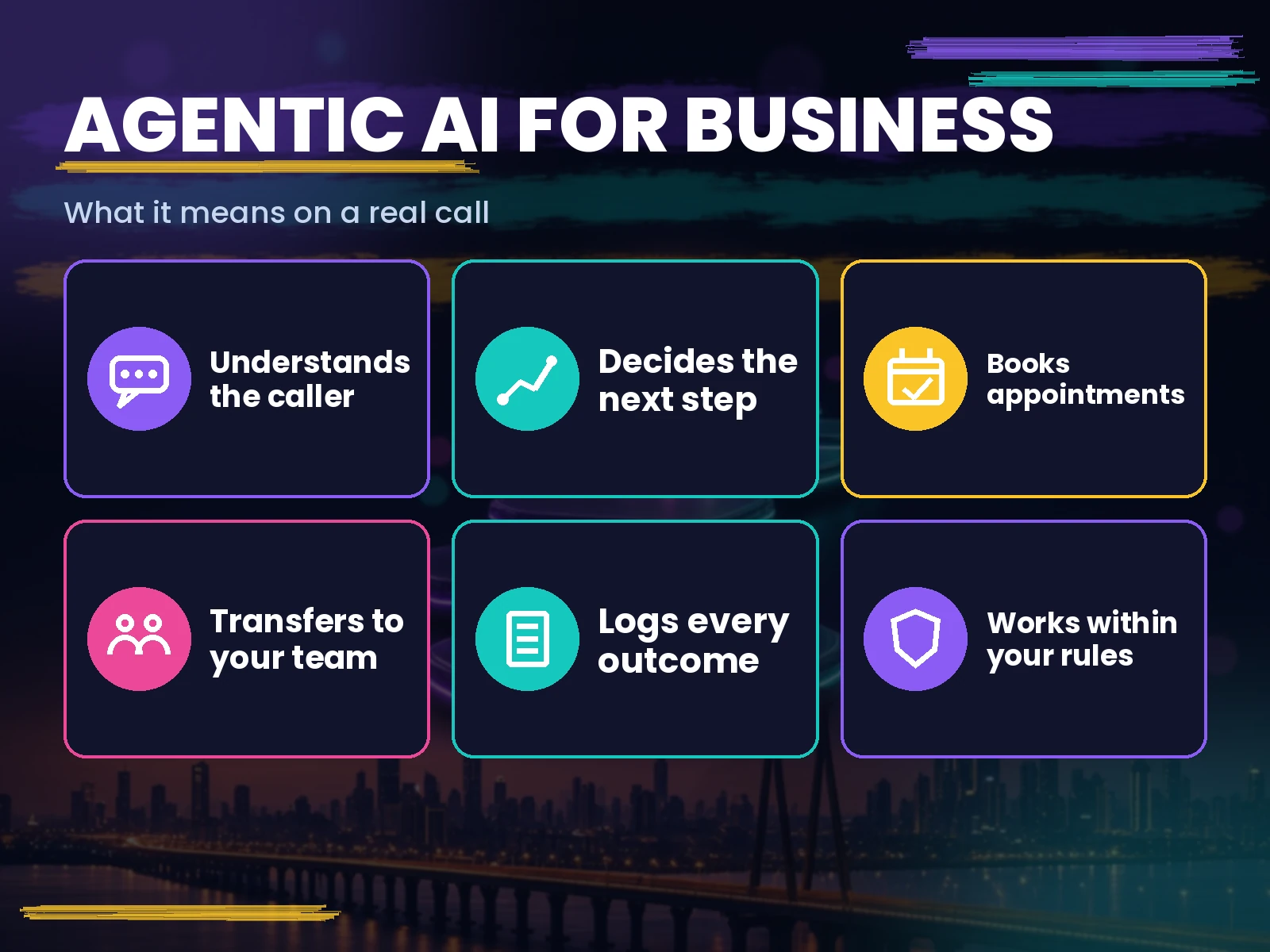
Agentic AI for business means AI that does not stop at giving an answer: it works out the next step towards a goal and takes it, within limits you set. On a phone call that looks like an agent choosing a follow-up question, booking a slot, transferring an interested caller to your team, scheduling a call-back or recording the outcome. The value lies in finishing routine tasks; the risk lies in acting without clear rules, so guardrails matter.
What does "agentic" actually mean?
Most AI that businesses met first was answer-shaped. You asked, it replied, and then everything else was up to you. Agentic AI is action-shaped. It is given an objective, it decides what to do next, it does it, it looks at what happened, and it carries on until the objective is met or it reaches a point where a person must take over.
The word describes a spectrum, not a switch. It helps to think of three levels of autonomy, and to decide which level each task deserves.
| Level | What the AI does | A business example |
|---|---|---|
| Suggests | Proposes the next step; a person carries it out | Drafts a reply to an enquiry for staff to send |
| Acts with approval | Prepares the action and waits for a yes | Prepares a refund for a manager to approve |
| Acts within limits | Takes the step itself, inside clear rules | Books a site visit during a call and logs it |
Agentic AI on a real phone call
A voice agent following up an enquiry for a coaching institute makes small decisions every few seconds. None of them is dramatic, and that is the point: agentic AI in business is mostly many sensible micro-decisions made quickly and consistently.
| When the caller says | The agent decides | And it |
|---|---|---|
| "I'm driving, call later." | This is not a no; it is a timing problem | Asks for a better time and schedules the call-back |
| "Which batches are there for Class 11?" | This is a fact it has in its notes | Answers briefly, then asks which timing suits |
| "What is the fee?" | Fees are for the team to discuss | Says the counsellor will share details and offers a transfer |
| "Okay, can I visit on Saturday?" | The goal is within reach | Offers two Saturday slots and confirms one |
| "Let me talk to someone." | A person is needed now | Transfers the call live to the counselling team |
| "Wrong number." | The task should end here | Apologises, ends the call and marks the number |
Every row is a choice the agent makes on its own, inside rules the institute wrote. No row involves the agent inventing a promise, quoting a discount or arguing with the caller.
The four actions that make a call agentic
Choosing the next question
It skips what it already knows and asks what moves the conversation forward.
Booking
It offers real options, confirms one and saves it for your team.
Transferring
It passes an interested or upset caller to the right person, live, with context.
Recording
It saves the recording, a transcript and a short summary with the outcome.

The fourth action is the one businesses underrate. Because an agentic system writes down what it did and why, a manager can review a day of calls in minutes, spot a pattern, such as callers asking about parking, and update the agent's notes the same afternoon.
Where is the hype in agentic AI?
Some of what is said about agentic AI is real today, and some of it is a pitch for the future. It pays to know which is which before you sign anything.
Real today
- Agents that complete narrow, repeated tasks such as follow-ups, confirmations and reminders
- Choosing between a handful of allowed actions during a conversation
- Handing over to people when a rule or a doubt calls for it
- Detailed records that make the work easy to check
Mostly hype, for now
- A "digital employee" that runs a department without supervision
- Agents that negotiate prices or close complex deals unaided
- Systems that never make a mistake, so need no review
- Setting it up once and never touching it again
A useful rule: if a claim would sound unreasonable about a new human hire in their first month, treat it with the same caution when it is made about an agent.
Free advice
Talk to our team about AI agents for your calls
Share your name and WhatsApp number. Our team will call you within 24 hours to understand your calls. No payment, no commitment.
Which business tasks suit agentic AI first?
The best first tasks share four traits. Run any idea through this list before you spend time on it.
- Repeated often: the same kind of conversation happens many times a week.
- A clear finish line: you can say exactly what a successful outcome looks like.
- Cheap to correct: if the agent slips, a person can fix it easily and nobody is harmed.
- Easy to check: the result shows up in a recording, a booking or a log you can read.
First calls to new enquiries, appointment confirmations, document reminders and event invitations pass all four. Debt disputes, medical advice and large negotiations fail at least two, so they stay with people.
Guardrails: how to keep agentic AI in its lane
Write one objective
One sentence, such as "book a counselling visit for interested enquiries".
List the allowed actions
Book, transfer, schedule a call-back, end politely. Anything not listed is off limits.
Name the hand-over triggers
Price talks, complaints, confusion and any request for a person go to your team.
Set the calling hours
Outbound calls stay within your calling hours, and refusals end the conversation for good.
Approve what it may say
Facts, offers and wording come from notes you have checked, not from guesswork.
Review the records weekly
Listen to a sample of calls, read the summaries and adjust the notes and rules.
How do you measure whether agentic AI is helping?
Skip vanity measures such as "conversations handled". Ask instead whether work that used to stall now gets finished, and whether your people spend more time on the conversations only they can have.
- How many tasks reached the finish line without a person stepping in.
- How many hand-overs were the right call, and how many your team felt were unnecessary.
- How quickly new enquiries got their first conversation, compared with before.
- What your team did with the hours that came back to them.
Our guide on measuring AI calling results sets out a simple weekly review you can adapt.
What is a sensible way to start with agentic AI?
Pick one call type, set the level of autonomy to "acts within limits", write tight guardrails and run it on a small group of customers before widening it. That is how Swara AI is set up: the calling agent works only inside your calling hours, offers bookings or call-backs, hands warm callers to your staff live and files a recording and summary for each call, in Hindi, English or the caller's regional language. If you would rather have the whole service handled for you, see how an AI calling company runs campaigns end to end.
Questions people ask
What is agentic AI in simple words?
AI that takes the next step towards a goal by itself, within rules you set, instead of only answering a question and waiting.
How is agentic AI different from generative AI?
Generative AI creates content such as text or speech. Agentic AI uses that ability to pursue a goal: it decides what to do, acts and checks the result. Most agentic systems use generative AI inside them.
Is agentic AI safe to use on customer calls?
It is when the goal is narrow, the allowed actions are listed, hand-over rules are clear and someone reviews the recordings. Without those, no AI should talk to your customers.
Can an agentic voice agent book appointments for us?
Yes. It can offer slots, confirm one and pass it to your team. Whether it writes straight into your calendar or records depends on how it is connected, so ask before you start.
Who is responsible when an agentic system gets something wrong?
The business that uses it. That is why the rules, the approved wording and the reviews should belong to someone on your team, not only to the provider.
Does agentic AI need a lot of data to start?
Not for a first task. Clear notes on your products and process, a short script and a list of allowed actions are usually enough. The records it creates then help you improve it.
Will agentic AI replace managers or sales staff?
No. It takes the routine first steps so people spend their time on judgement, relationships and closing. Someone still has to set the goals and review the work.
What does human-in-the-loop mean?
A design in which a person approves, checks or takes over at chosen points. On calls, that usually means live transfers and regular review of summaries.
Is agentic AI only for large enterprises?
No. A single agent following up enquiries can matter more to a small business with a two-person team than to a large company with a full call centre.
What does Swara AI do on an agentic call?
It follows the goal and rules you approve, answers from your notes, books or schedules a call-back, transfers interested callers to your team within your calling hours and sends a report of the call.
Questions about AI calling for your business?
Ask our AI agent. It answers in seconds, at any time of day.
Get a call back within 24 hours
Leave your name and number. Our team will call you within 24 hours to understand your calls and explain whether an AI calling agent fits your business.
- No payment or commitment
- Your details are used only to reply to your enquiry
- Prefer to type? Ask our AI agent in the chat